Archer House
Stay Updated
Donate
  • About
  • History of House 88
  • The Fund to End Antisemitism,
    Extremism, and Hate
  • News
  • Stay Updated
  • Donate
Sign Up
Donate
  • Photographer Reframes a Holocaust Victim’s Final Journey Through the Lenses She Once Crafted

    Photographer Reframes a Holocaust Victim’s Final Journey Through the Lenses She Once Crafted

    kburnet

    June 30, 2026
    ARCHER in the News
  • From Auschwitz Francesco Lotoro brings back to life the notes of the deportees

    From Auschwitz Francesco Lotoro brings back to life the notes of the deportees

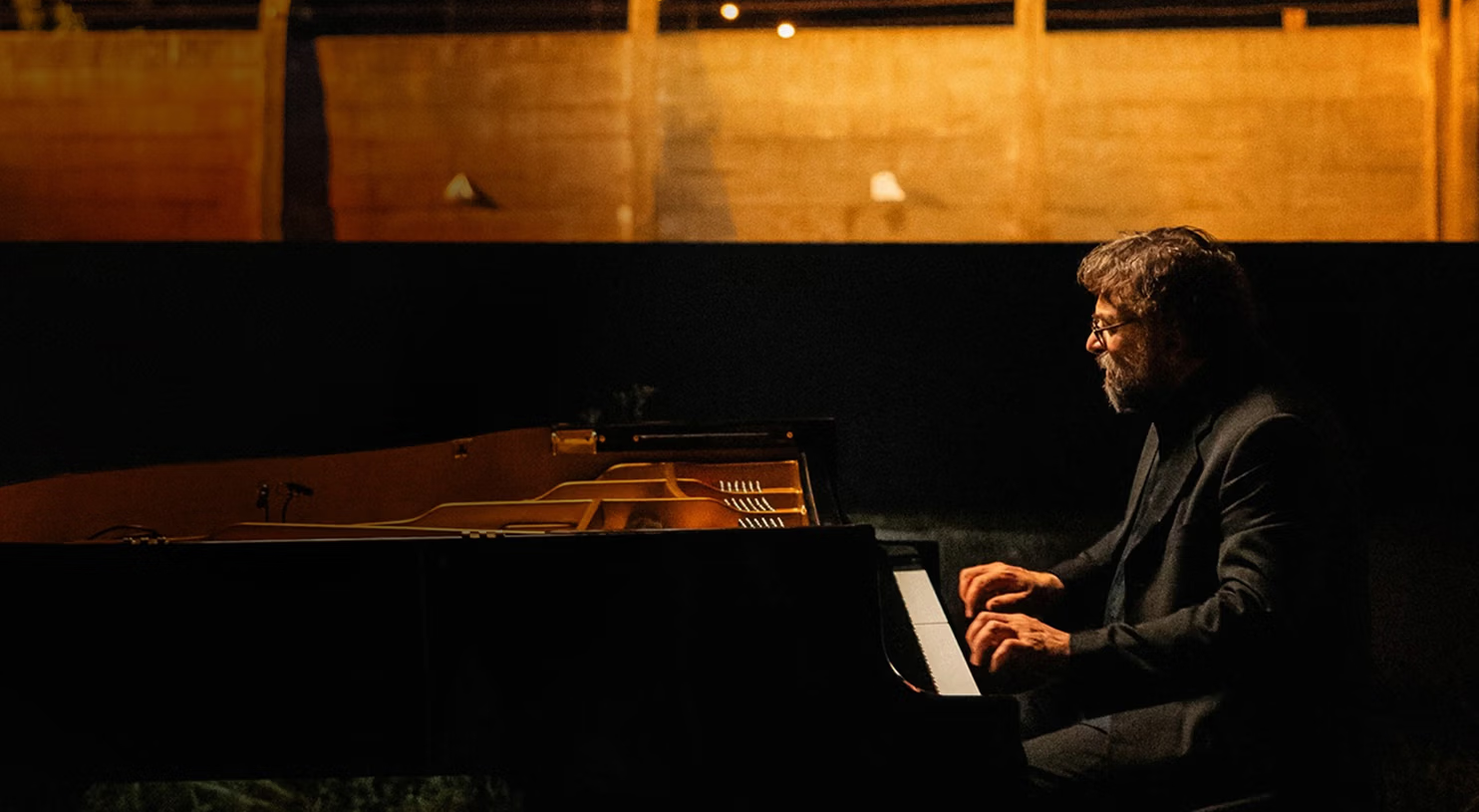
    The house at 88 Legionów Street, in Oświęcim, is leaning against the wall of the Auschwitz extermination camp. It was for years the house where Rudolf Höss, commander of the camp from 1940 to 1944, built a seemingly normal family life – gardens, swimming pool, greenhouses – while a few meters away he organized the greatest extermination in history. Since January 2025, after decades in private hands, the villa was acquired by the Counter Extremism Project and transformed into the Archer project, an international research center against anti-Semitism and extremism, under the patronage of UNESCO and in collaboration with the Auschwitz-Birkenau Museum. It is here that on June 11th there will be a concert by the composer, conductor and musicologist Francesco Lotoro, with the baritone Angelo De Leonardis. The program will be dedicated to music composed in concentration camps and almost erased by the Shoah: scores annotated on paper fragments or transcribed by heart, saved by Lotoro in over thirty years of commitment to collect, catalog and return this music to the public. The concert, promoted by the Counter Extremism Project, includes first world and Polish performances of works from the Italian composer’s archive.

    It is not the first time that Lotoro plays within those walls: in 2025 he had already been invited to perform in the “Francesco Lotoro Sound Hall”, the hall dedicated to concentration music named after him by the Counter Extremism Project. On that occasion the master had expressed the hope that “the works recovered in the camps, and performed in the same rooms that housed the supreme evil, could accompany the work of contrast to that hatred that created the unspeakable conditions in which they were written”.

    The following day, Friday, June 12 at 6:00 p.m., Lotoro will be in concert at the Ceremonial Hall of the Jewish Cemetery in Bielsko-Biała (920 Cieszyńska street), in an appointment organized by the BCK.

    ahouseadmin

    June 9, 2026
    ARCHER in the News
  • Francesco Lotoro from Barcelona in concert to remember the music composed during the Holocaust

    Francesco Lotoro from Barcelona in concert to remember the music composed during the Holocaust

    On June 11, a unique concert at Archer House 88 (the former residence of Rudolf Höss, commander of the infamous Auschwitz Extermination Camp) by the Counter Extremism Project a concert will bring back to public consciousness the music written in the Camps and almost erased by the atrocities of the Holocaust.

    Works written on sheets of paper or transcribed by heart, which testify to a cultural brilliance almost extinguished during the greatest tragedy of the twentieth century. Music saved and performed by the pianist, composer, conductor and musicologist Francesco Lotoro who will also perform with the baritone Angelo De Leonardis on the occasion. On June 12, Lotoro will again be in concert at the Ceremonial Hall of the Jewish Cemetery in Bielsko-Biała (Poland).

    ahouseadmin

    June 9, 2026
    ARCHER in the News
  • Q&A with Elliott Broidy on Receiving the Visionary Award at the Jewish Heritage Celebration on Capitol Hill

    Q&A with Elliott Broidy on Receiving the Visionary Award at the Jewish Heritage Celebration on Capitol Hill

    Citybiz | By Staff

    June 5, 2026

    Today we’re speaking with entrepreneur and philanthropist Elliott Broidy, the Chairman and CEO of Broidy Capital Holdings, LLC and founder of multiple companies focused on defense, homeland security, AI, and public safety technologies.

    Elliott Broidy is deeply involved in philanthropic and educational initiatives supporting Jewish causes and recently received the Visionary Award at the annual Jewish American Heritage Month Celebration on Capitol Hill in Washington, D.C. in recognition of his leadership in national security, Jewish advocacy, education, and combating antisemitism.

    Elliott, congratulations on receiving the Visionary Award. What does this recognition mean to you?

    Thank you. As a proud Jewish American, the award is profoundly meaningful to me on two levels: because it is connected to Jewish American Heritage Month and because I received it in our nation’s capital.

    I have always believed that success comes with responsibility. I have been fortunate in business, and I have tried to use that success not only to build companies, but also to support causes that strengthen our communities, protect public safety, preserve Jewish history, and combat antisemitism. To be recognized for that work is humbling, and I am grateful to Project Legacy for having honored me in this way.

    A major focus of your philanthropy has been Jewish causes and combating antisemitism. Why has that become such a priority for you?

    The events of recent years — and especially on and after October 7 — have made clear that antisemitism is not a relic of history. It is an acute and growing threat that must be confronted seriously and proactively.

    One of the projects I am particularly proud to support is ARCHER at House 88, the Auschwitz Research Center on Hate, Extremism, and Radicalization, which is located in the former home of Rudolf Höss, the commandant of Auschwitz, in Oświęcim, Poland. You may know the house from the Oscar-winning film The Zone of Interest, in which it is prominently featured. Höss lived in splendor in that house with his wife and five children while orchestrating genocide just next door in the camp.

    There is something profoundly meaningful about transforming a place once associated with the administration of mass murder into a center dedicated to combating hatred, extremism, and antisemitism, using the most cutting-edge of technologies in doing so.

    As necessary as it is to study the past, we must be active in the present, because as I just mentioned, hatred of Jews and other forms of extremism have not gone away. In some instances, they have mutated, but at bottom they are the same primordial hatreds we have seen before. It is incumbent on us to understand how extremist ideologies evolve and how to recognize warning signs before tragedy occurs. We are living in a time where information moves faster than ever. Hatred hitches a ride to this torrent of information, which is why we are witnessing a veritable explosion of it online. That extremism, of course, spills into the real world and has horrible consequences: intimidation, violence, and murder.

    Institutions focused on research, education, and public awareness are critically important if we want future generations to understand both the horrors of the past and the responsibility they carry moving forward.

    You acquired an original architectural drawing of the Auschwitz-Birkenau crematoria. What motivated you to do that?

    The drawing is an extraordinary and haunting historical artifact. When I learned it was available, I felt strongly that it needed to be exhibited prominently as a lesson for all time.

    There are people in the world who try to minimize, distort, or deny the Holocaust. A deeply disturbing Economist/YouGov poll published in December 2023 found that one out of five Americans aged 18-29 believe that the Holocaust is a myth. That statistic rang alarm bells for me. That number should be zero.

    Physical artifacts matter because they confront denial with undeniable evidence. They remind people that these events were real, systematic, and engineered by human beings.

    The amount that I spent for the drawing – $1.5 million – was deliberately chosen to honor the memory of the 1.5 million Jewish children murdered by the Nazis. Ponder that number for a moment. One and a half million. It is unbearable. One and a half million young lives snuffed out, in service of a lunatic and evil ideology. One and a half million children murdered for the “crime” of being born Jewish. They were denied a future literally because they had been born.

    That money will go toward a global early childhood curriculum that will place emphasis on altruism and empathy, which are key attributes that we need to instill in children early to inoculate them against the viruses of antisemitism, extremism, and hatred.

    For me, preserving this artifact is about helping to ensure that future generations understand where hatred and dehumanization can lead if societies become complacent.

    Your business career has focused heavily on public safety, defense, and emerging technology. What draws you to those sectors?

    After 9/11, I felt a profound sense that I wanted my professional life to contribute more directly to protecting people and strengthening national security. That awful day changed the trajectory of my entire career.

    My focus is on founding, investing in, and managing companies working in defense, homeland security, AI, and public safety. For example, my company LEO Technologies helps law enforcement agencies better manage overwhelming amounts of information so investigators can spend more time protecting communities and solving cases.

    Technology is advancing rapidly, and I believe it can be an enormously positive force when applied responsibly – such as the ways ARCHER at House 88 is leveraging its power to go after the financing networks of extremist organizations. Some of the most important innovations today are the ones that help keep people safe, and I am happy to contribute to that.

    What do you hope your legacy will be?

    I would like to be remembered as someone who tried to use his opportunities constructively — to build businesses, create jobs, support important causes, and help strengthen institutions that matter.

    I also hope people will remember that I cared deeply about protecting Jewish life and preserving Jewish history during a period when both became increasingly important. The fight against antisemitism, extremism, and historical ignorance is not someone else’s responsibility. It belongs to all of us.

    At the same time, I hope my children and future generations understand that success is not measured only financially. It is measured by whether you leave a positive impact on other people and whether you use your position to help others succeed as well.

    What advice would you give to younger entrepreneurs and business leaders?

    Stay resilient and stay curious.

    Every successful person experiences setbacks, disappointments, and failures. The difference is whether you allow those moments to define you or whether you treat them as opportunities to learn and improve.

    I would also encourage younger leaders to think beyond quarterly results and ask themselves what kind of impact they want to have over the long term. Building a successful company is important, but building a meaningful life is even more important.

    View Article

    ahouseadmin

    June 5, 2026
    ARCHER in the News
  • Financial Times: Should the Auschwitz commandant’s house be hosting exhibitions?


    Read full article here.

    In early 2025, the Counter Extremism Project (CEP), a US-based NGO, announced the purchase of the house from a Polish family for an undisclosed sum. The property had already drawn international attention through Jonathan Glazer’s Oscar-winning film The Zone of Interest. For his movie, Glazer recreated the house on a set using a nearby abandoned building.

    The new owners of the Höss home, whose project is called the Auschwitz Research Center on Hate, Extremism and Radicalization (Archer) at House 88, stripped back the walls and removed Communist-era ceilings in order to restore the property as closely as possible to its wartime state without fully renovating it. Only a handful of original features remain, including an iron staircase balustrade and a bathroom lock disturbingly marked either “Frei” or “Besetz”: free or occupied. One room displays an SS cup and other kitchenware, alongside the striped pyjamas of a Polish Auschwitz prisoner discovered in the roof structure.

    Mark Wallace, head of CEP and a former US ambassador to the UN under President George W Bush, says “the house is in many ways the definition of the heart of darkness, of the ideology that drove the Shoah.” 

    House 88 sits beside the Auschwitz museum that drew almost 2mn people in 2025, making it one of Poland’s most visited sites. To ease overcrowding, the museum stopped this year selling on-site tickets, requiring visitors to book online in advance. 

    kburnet

    May 15, 2026
    ARCHER in the News
  • Counter Extremism Project’s ARCHER at House 88 to Present New Exhibition by Photographer Hannah Altman, Retracing the Physical and Emotional Journey of Holocaust Victim Lore Sternfeld

    Counter Extremism Project’s ARCHER at House 88 to Present New Exhibition by Photographer Hannah Altman, Retracing the Physical and Emotional Journey of Holocaust Victim Lore Sternfeld

    Vintage Astro-Berlin Lenses, Like Those Sternfeld Crafted, Are Used to Depict the Path from Berlin to Auschwitz

    Hannah Altman exhibition

    Oświęcim, Poland (April 30, 2026) – The Counter Extremism Project (CEP) is proud to organize Ground Glass: Reframing the World of Lens-Maker and Holocaust Victim Lore Sternfeld, a new exhibition by Jewish-American photographer Hannah Altman (b. 1995). The exhibition honors the life and work of Holocaust victim Lore Sternfeld (1915-1943), a precision engineer who made camera lenses for Astro-Berlin, the same company whose lenses were used by Nazi propagandists including filmmaker Leni Riefenstahl. Beginning June 21, 2026, Ground Glass will be on view at the former home of Auschwitz commandant Rudolf Höss, now the Auschwitz Research Center on Hate, Extremism and Radicalization (ARCHER) at House 88 in Oświęcim, Poland. The site functions as a center for counter-extremism research, advocacy, and art.

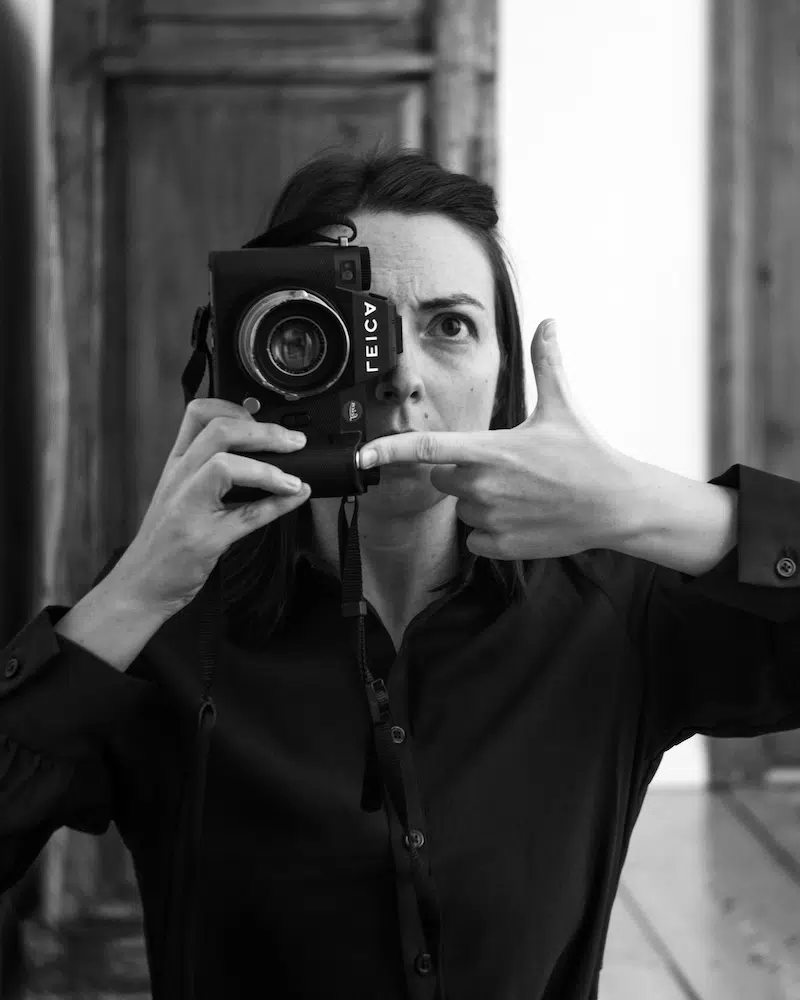
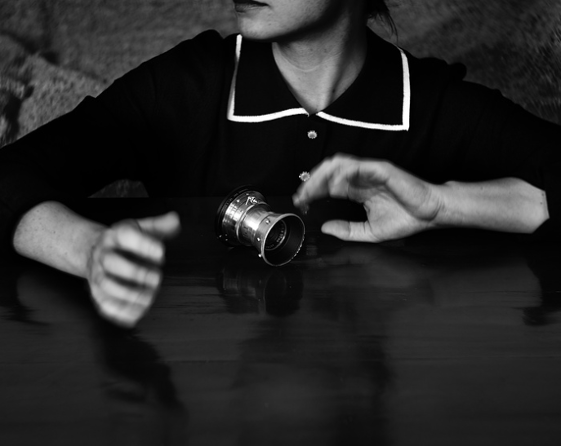
    In early 2025 CEP acquired several Pan-Tachar lenses made by Astro Berlin during Lore’s time as an Astro Berlin lens mechanic, and in collaboration with London-based cinematic company Focus Canning, has restored, refurbished, and fit them on a modern camera. Altman used these lenses to imagine Lore Sternfeld’s inner world during the final winter of her life and to retrace her path from Berlin to Auschwitz on the 83rd anniversary of her deportation.

    The first images of Ground Glass were made in a sparsely furnished Berlin apartment, using only two small rooms as the primary setting. Through the vintage lenses, Altman transformed the rooms into psychological and narrative settings, often using household found items such as eggshells, a cutting board, and Judaica, outfitted in a wardrobe that approximated Sternfeld’s documented attire.

    On the anniversary of Sternfeld’s deportation, Altman boarded a train toward Auschwitz, documenting each stage of Sternfeld’s final journey along the way. In addition, Altman made photographs in the former home of Rudolf Höss, which directly overlooks the Auschwitz barracks.

    “This project was, by necessity, deeply personal,” said Hannah Altman. “Merging historical record with artistic intuition, these photographs pay witness to Lore while acknowledging that her story has unfillable gaps. As I moved through this project, I felt as if Lore’s vision merged with my own. Using a collection of these reclaimed lenses to build a speculative study of Lore’s final months, I felt a powerful connection to her specific story as well as a heightened sense of the experiences we do share: those of being a young Ashkenazi woman, confined and uneasy within a limited space. In this sense, the project acknowledges the impossibility of filling the gaps, instead focusing on the opportunity to build upon her unknown inner world with empathy and expansiveness.”

    According to Altman, the Astro-Berlin lenses had their own personalities, introducing distortions, flares, and a softened light shaping the images. Retrofitted onto the body of a Leica digital camera, Altman sought to collaborate with the lenses, allowing their character to guide the work. Their distinct distortions and visual unpredictability echoed the atmosphere of Berlin during the WWII era, adding a profound sense of self-realization to the project.

    “The lenses themselves have the almost ghostly quality of a bygone era, and there were moments when we felt Lore was in the workshop with us,” said Ben Mitchell, Managing Director of Focus Canning, who worked with his team to restore the lenses. “It was sobering but particularly meaningful to think of Lore as a fellow colleague of the craft, separated by almost a century. The work was one of raw emotion and struggle, but also profound satisfaction that we were playing our small part in reminding the world of her name.”

    On the significance of this project to CEP’s work, CEP CEO Ambassador Mark D Wallace said:
    “These lenses, or lenses like them, passed through Lore’s hands. As a lens mechanic, she peered through them with her own eyes, shaping them for use by an ideology of extremism and hate. She was later murdered by the Nazis at Auschwitz. Today, as propaganda runs rampant online, inspiring the continued murder of Jews and other innocents, we will ask our visitors to take Lore’s lenses into their own hands, look through them as if through Lore’s own eyes, and turn them back upon her murderers. Hannah Altman has brilliantly captured Lore Sternfeld’s legacy and her final journey with extraordinary empathy. We hope visitors will respond to that empathy with their own act of resilience and defiance — through the lenses of Lore Sternfeld.”

    The exhibition features 18 photographs. Roughly two-thirds of the images are black and white. When color appears, it is restrained within a narrow tonal range of warm oranges or brief moments of sunlight. Although some images lean toward the surreal, the group as a whole remains grounded in a specific environment and emotional landscape.

    The vintage lenses that Altman used will be displayed alongside the exhibition, and visitors will be given opportunities to use them to create photographs of their own. Also on view will be the few existing documentational fragments of Sternfeld’s life. 

    About Hannah Altman
    Hannah Altman is a photographer based in Boston, MA, whose work considers storytelling and the porosity between memory and myth. She holds an MFA from Virginia Commonwealth University. Her photobooks Kavana (Kris Graves Projects, 2020) and We Will Return to You (Saint Lucy Books, 2025) are held in libraries including the Museum of Modern Art, the Metropolitan Museum of Art, the Getty, Harvard University, and Stanford University.

    Altman’s photographs have been published in The New York Times, Artforum, Vanity Fair, Harper’s Magazine, LensCulture, and British Journal of Photography. Her work has been exhibited at institutions such as the Virginia Museum of Contemporary Art, MK&G Hamburg, Houston Center for Photography, Koffler Arts, Athens Photo Festival, Ogden Museum of Southern Art, and Silver Eye Center for Photography.

    She was the inaugural Blanksteen Artist in Residence at the Slifka Center for Jewish Life at Yale in 2022. Recent recognition includes: 2022 Hopper Prize finalist, 2022 Portraits Hellerau Photography Award First Prize winner, 2023 Innovate Grant recipient, 2023 Aperture Portfolio Prize finalist, 2025 Arnold Newman Prize honorable mention, and Cultured Magazine’s 2025 Young Photographers List nomination.

    About the Counter Extremism Project and ARCHER at House 88
    The Counter Extremism Project is a not-for-profit, non-partisan, international policy organization formed to combat the growing threat from extremist ideologies. The Auschwitz Research Center on Hate, Extremism, and Radicalization (ARCHER at House 88) is a unique new initiative of the Counter Extremism Project (CEP). Situated directly outside the wall of the Auschwitz-Birkenau concentration and death camps, House 88 was once the home of camp commandant Rudolf Höss, who built an idyllic life for his family while organizing one of history’s most atrocious mass murders next door. CEP has acquired the house and transformed it into a center for combating antisemitism and extremism through research, education, advocacy, and art. As part of this mission, we are dedicated to a form of Holocaust education that not only memorializes victims but also allows their stories to provide a strong response to the crisis facing Jews today.

    Media Contacts
    Keith Burnet
    +44 7714 200920

    kburnet

    April 30, 2026
    Press Releases
  • Counter Extremism Project and ARCHER at House 88 Announce Partnership with Federal Foreign Ministry of Germany for Musical Concert at Kennedy Center: “Enduring Music: Compositions from the Holocaust”

    The Counter Extremism Project (CEP) and ARCHER at House 88 are honored to announce our official partnership with the Federal Foreign Ministry of Germany for Enduring Music: Compositions from the Holocaust, presented at the John F. Kennedy Center for the Performing Arts on International Holocaust Remembrance Day, January 27, 2026.

    ahouseadmin

    January 23, 2026
    Press Releases
  • Counter Extremism Project and ARCHER at House 88 Announce Partnership with Embassy of Israel in Washington. D.C. for Musical Concert at Kennedy Center: “Enduring Music: Compositions from the Holocaust”

    This partnership reflects a shared commitment to remembrance, historical truth, and the responsibility to confront today’s antisemitism and extremism. By supporting a concert that brings back to life music composed in ghettos and death camps—often written on scraps of paper or preserved only in memory— the Embassy of Israel in Washington, D.C. is helping to ensure that the voices of those murdered in the Holocaust continue to be heard with dignity and clarity. Through this partnership, CEP and ARCHER (Auschwitz Research Center on Hate, Extremism and Radicalization) at House 88, together with Israel reaffirm a shared purpose: to preserve memory, honor the victims of the Holocaust, and ensure that the past continues to speak with moral clarity to the present.

    ahouseadmin

    January 22, 2026
    Press Releases
  • Counter Extremism Project and ARCHER at House 88 Announce Partnership with Embassy of the Republic of Poland in Washington, D.C. for Musical Concert at Kennedy Center: “Enduring Music: Compositions from the Holocaust”

    This partnership reflects a shared commitment to remembrance, historical truth, and the responsibility to confront today’s antisemitism and extremism. By supporting a concert that brings back to life music composed in ghettos and death camps—often written on scraps of paper or preserved only in memory—Poland is helping to ensure that the voices of those murdered in the Holocaust continue to be heard with dignity and clarity. Through this partnership, CEP and ARCHER (Auschwitz Research Center on Hate, Extremism and Radicalization) at House 88, together with Poland reaffirm a shared purpose: to preserve memory, honor the victims of the Holocaust, and ensure that the past continues to speak with moral clarity to the present.

    ahouseadmin

    January 20, 2026
    Press Releases
  • “From Nuremberg to Now” Campaign

    “From Nuremberg to Now” Campaign

    Rudolf Höss, Commandant of Auschwitz, testified at Nuremberg as a witness with no attempt to deny his crimes.His highly consequential words changed the course of the trials and exposed how atrocity can be made ordinary. With the From Nuremberg to Now campaign, ARCHER at House 88 stands to tell the truth and prevent the normalization of antisemitism and extremism.

    ahouseadmin

    November 9, 2025
    Videos
1 2 3
Next Page

ARCHER at House 88

The Auschwitz Research Center on Hate, Extremism, and Radicalization

  • X
  • Instagram
  • Facebook
Donate

A CEP Project

©2001-2025 All Rights Reserved.  Privacy Policy | Terms of Use