Archer House
Stay Updated
Donate
  • About
  • History of House 88
  • The Fund to End Antisemitism,
    Extremism, and Hate
  • News
  • Stay Updated
  • Donate
Sign Up
Donate
  • From Auschwitz Francesco Lotoro brings back to life the notes of the deportees

    From Auschwitz Francesco Lotoro brings back to life the notes of the deportees

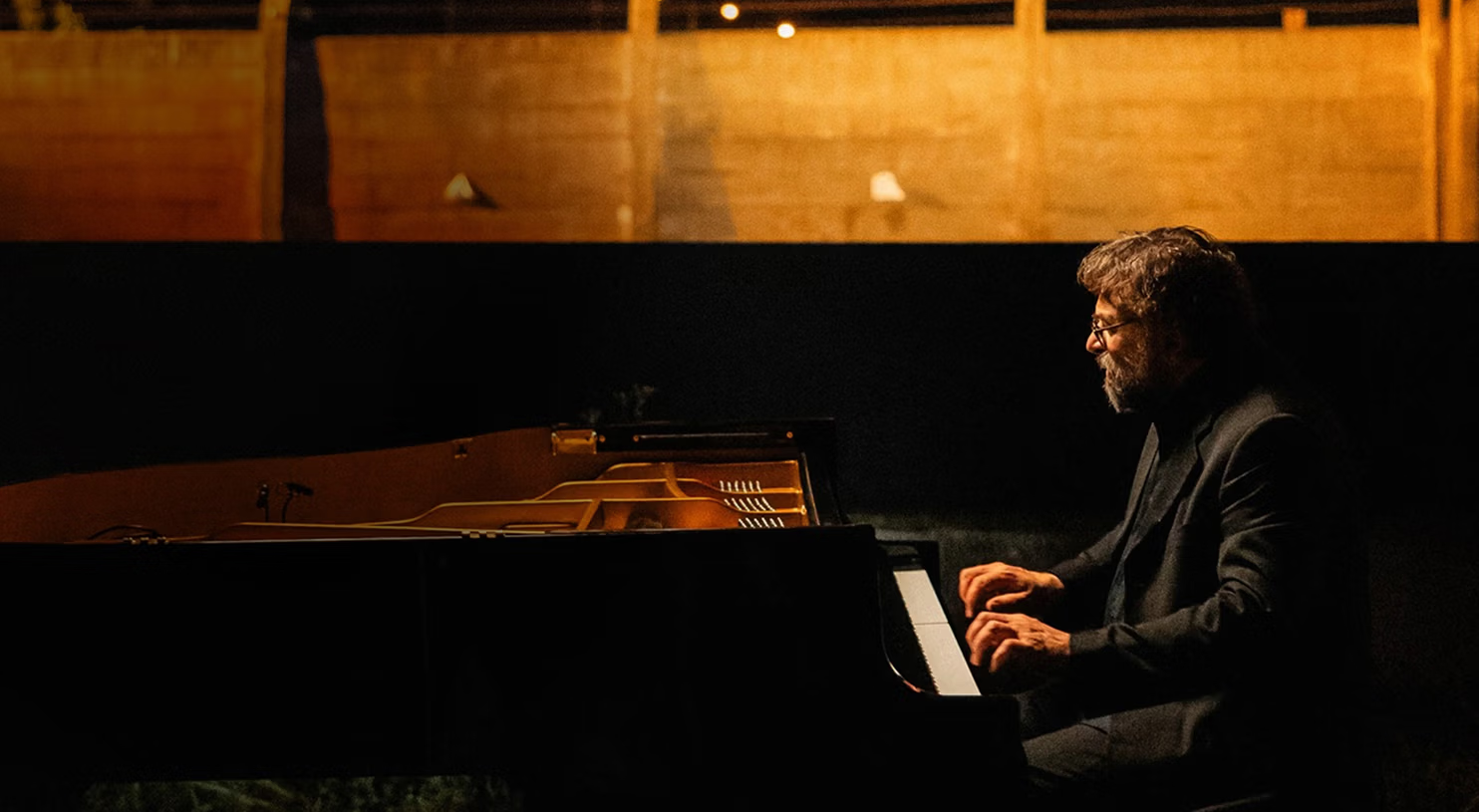
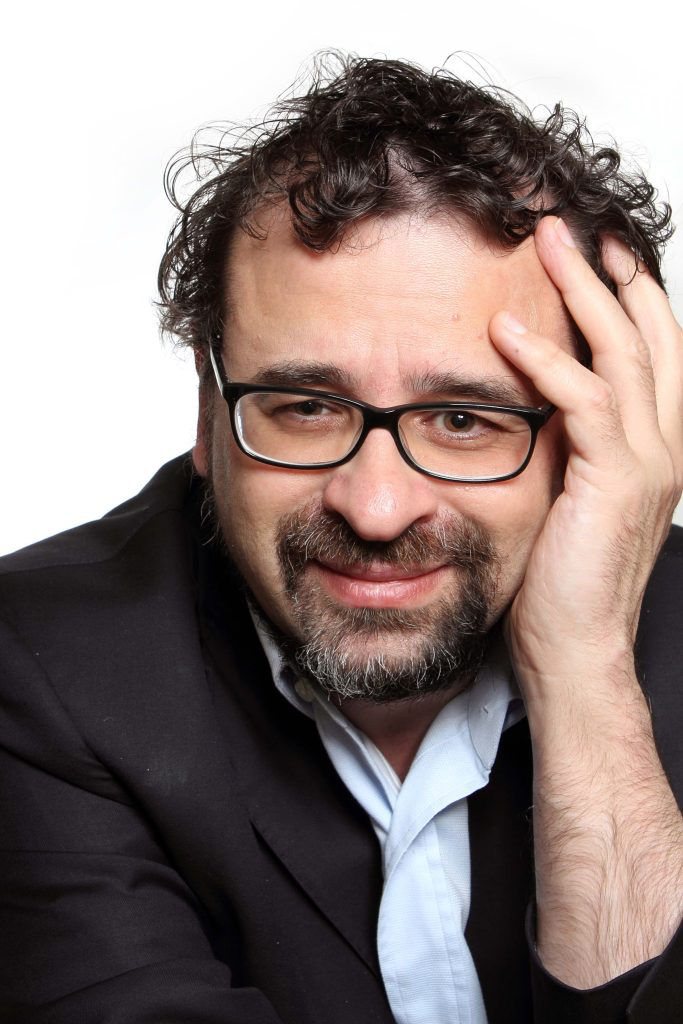
    The house at 88 Legionów Street, in Oświęcim, is leaning against the wall of the Auschwitz extermination camp. It was for years the house where Rudolf Höss, commander of the camp from 1940 to 1944, built a seemingly normal family life – gardens, swimming pool, greenhouses – while a few meters away he organized the greatest extermination in history. Since January 2025, after decades in private hands, the villa was acquired by the Counter Extremism Project and transformed into the Archer project, an international research center against anti-Semitism and extremism, under the patronage of UNESCO and in collaboration with the Auschwitz-Birkenau Museum. It is here that on June 11th there will be a concert by the composer, conductor and musicologist Francesco Lotoro, with the baritone Angelo De Leonardis. The program will be dedicated to music composed in concentration camps and almost erased by the Shoah: scores annotated on paper fragments or transcribed by heart, saved by Lotoro in over thirty years of commitment to collect, catalog and return this music to the public. The concert, promoted by the Counter Extremism Project, includes first world and Polish performances of works from the Italian composer’s archive.

    It is not the first time that Lotoro plays within those walls: in 2025 he had already been invited to perform in the “Francesco Lotoro Sound Hall”, the hall dedicated to concentration music named after him by the Counter Extremism Project. On that occasion the master had expressed the hope that “the works recovered in the camps, and performed in the same rooms that housed the supreme evil, could accompany the work of contrast to that hatred that created the unspeakable conditions in which they were written”.

    The following day, Friday, June 12 at 6:00 p.m., Lotoro will be in concert at the Ceremonial Hall of the Jewish Cemetery in Bielsko-Biała (920 Cieszyńska street), in an appointment organized by the BCK.

    ahouseadmin

    June 9, 2026
    ARCHER in the News
  • Francesco Lotoro from Barcelona in concert to remember the music composed during the Holocaust

    Francesco Lotoro from Barcelona in concert to remember the music composed during the Holocaust

    On June 11, a unique concert at Archer House 88 (the former residence of Rudolf Höss, commander of the infamous Auschwitz Extermination Camp) by the Counter Extremism Project a concert will bring back to public consciousness the music written in the Camps and almost erased by the atrocities of the Holocaust.

    Works written on sheets of paper or transcribed by heart, which testify to a cultural brilliance almost extinguished during the greatest tragedy of the twentieth century. Music saved and performed by the pianist, composer, conductor and musicologist Francesco Lotoro who will also perform with the baritone Angelo De Leonardis on the occasion. On June 12, Lotoro will again be in concert at the Ceremonial Hall of the Jewish Cemetery in Bielsko-Biała (Poland).

    ahouseadmin

    June 9, 2026
    ARCHER in the News
  • Q&A with Elliott Broidy on Receiving the Visionary Award at the Jewish Heritage Celebration on Capitol Hill

    Q&A with Elliott Broidy on Receiving the Visionary Award at the Jewish Heritage Celebration on Capitol Hill

    Citybiz | By Staff

    June 5, 2026

    Today we’re speaking with entrepreneur and philanthropist Elliott Broidy, the Chairman and CEO of Broidy Capital Holdings, LLC and founder of multiple companies focused on defense, homeland security, AI, and public safety technologies.

    Elliott Broidy is deeply involved in philanthropic and educational initiatives supporting Jewish causes and recently received the Visionary Award at the annual Jewish American Heritage Month Celebration on Capitol Hill in Washington, D.C. in recognition of his leadership in national security, Jewish advocacy, education, and combating antisemitism.

    Elliott, congratulations on receiving the Visionary Award. What does this recognition mean to you?

    Thank you. As a proud Jewish American, the award is profoundly meaningful to me on two levels: because it is connected to Jewish American Heritage Month and because I received it in our nation’s capital.

    I have always believed that success comes with responsibility. I have been fortunate in business, and I have tried to use that success not only to build companies, but also to support causes that strengthen our communities, protect public safety, preserve Jewish history, and combat antisemitism. To be recognized for that work is humbling, and I am grateful to Project Legacy for having honored me in this way.

    A major focus of your philanthropy has been Jewish causes and combating antisemitism. Why has that become such a priority for you?

    The events of recent years — and especially on and after October 7 — have made clear that antisemitism is not a relic of history. It is an acute and growing threat that must be confronted seriously and proactively.

    One of the projects I am particularly proud to support is ARCHER at House 88, the Auschwitz Research Center on Hate, Extremism, and Radicalization, which is located in the former home of Rudolf Höss, the commandant of Auschwitz, in Oświęcim, Poland. You may know the house from the Oscar-winning film The Zone of Interest, in which it is prominently featured. Höss lived in splendor in that house with his wife and five children while orchestrating genocide just next door in the camp.

    There is something profoundly meaningful about transforming a place once associated with the administration of mass murder into a center dedicated to combating hatred, extremism, and antisemitism, using the most cutting-edge of technologies in doing so.

    As necessary as it is to study the past, we must be active in the present, because as I just mentioned, hatred of Jews and other forms of extremism have not gone away. In some instances, they have mutated, but at bottom they are the same primordial hatreds we have seen before. It is incumbent on us to understand how extremist ideologies evolve and how to recognize warning signs before tragedy occurs. We are living in a time where information moves faster than ever. Hatred hitches a ride to this torrent of information, which is why we are witnessing a veritable explosion of it online. That extremism, of course, spills into the real world and has horrible consequences: intimidation, violence, and murder.

    Institutions focused on research, education, and public awareness are critically important if we want future generations to understand both the horrors of the past and the responsibility they carry moving forward.

    You acquired an original architectural drawing of the Auschwitz-Birkenau crematoria. What motivated you to do that?

    The drawing is an extraordinary and haunting historical artifact. When I learned it was available, I felt strongly that it needed to be exhibited prominently as a lesson for all time.

    There are people in the world who try to minimize, distort, or deny the Holocaust. A deeply disturbing Economist/YouGov poll published in December 2023 found that one out of five Americans aged 18-29 believe that the Holocaust is a myth. That statistic rang alarm bells for me. That number should be zero.

    Physical artifacts matter because they confront denial with undeniable evidence. They remind people that these events were real, systematic, and engineered by human beings.

    The amount that I spent for the drawing – $1.5 million – was deliberately chosen to honor the memory of the 1.5 million Jewish children murdered by the Nazis. Ponder that number for a moment. One and a half million. It is unbearable. One and a half million young lives snuffed out, in service of a lunatic and evil ideology. One and a half million children murdered for the “crime” of being born Jewish. They were denied a future literally because they had been born.

    That money will go toward a global early childhood curriculum that will place emphasis on altruism and empathy, which are key attributes that we need to instill in children early to inoculate them against the viruses of antisemitism, extremism, and hatred.

    For me, preserving this artifact is about helping to ensure that future generations understand where hatred and dehumanization can lead if societies become complacent.

    Your business career has focused heavily on public safety, defense, and emerging technology. What draws you to those sectors?

    After 9/11, I felt a profound sense that I wanted my professional life to contribute more directly to protecting people and strengthening national security. That awful day changed the trajectory of my entire career.

    My focus is on founding, investing in, and managing companies working in defense, homeland security, AI, and public safety. For example, my company LEO Technologies helps law enforcement agencies better manage overwhelming amounts of information so investigators can spend more time protecting communities and solving cases.

    Technology is advancing rapidly, and I believe it can be an enormously positive force when applied responsibly – such as the ways ARCHER at House 88 is leveraging its power to go after the financing networks of extremist organizations. Some of the most important innovations today are the ones that help keep people safe, and I am happy to contribute to that.

    What do you hope your legacy will be?

    I would like to be remembered as someone who tried to use his opportunities constructively — to build businesses, create jobs, support important causes, and help strengthen institutions that matter.

    I also hope people will remember that I cared deeply about protecting Jewish life and preserving Jewish history during a period when both became increasingly important. The fight against antisemitism, extremism, and historical ignorance is not someone else’s responsibility. It belongs to all of us.

    At the same time, I hope my children and future generations understand that success is not measured only financially. It is measured by whether you leave a positive impact on other people and whether you use your position to help others succeed as well.

    What advice would you give to younger entrepreneurs and business leaders?

    Stay resilient and stay curious.

    Every successful person experiences setbacks, disappointments, and failures. The difference is whether you allow those moments to define you or whether you treat them as opportunities to learn and improve.

    I would also encourage younger leaders to think beyond quarterly results and ask themselves what kind of impact they want to have over the long term. Building a successful company is important, but building a meaningful life is even more important.

    View Article

    ahouseadmin

    June 5, 2026
    ARCHER in the News
  • Financial Times: Should the Auschwitz commandant’s house be hosting exhibitions?


    Read full article here.

    In early 2025, the Counter Extremism Project (CEP), a US-based NGO, announced the purchase of the house from a Polish family for an undisclosed sum. The property had already drawn international attention through Jonathan Glazer’s Oscar-winning film The Zone of Interest. For his movie, Glazer recreated the house on a set using a nearby abandoned building.

    The new owners of the Höss home, whose project is called the Auschwitz Research Center on Hate, Extremism and Radicalization (Archer) at House 88, stripped back the walls and removed Communist-era ceilings in order to restore the property as closely as possible to its wartime state without fully renovating it. Only a handful of original features remain, including an iron staircase balustrade and a bathroom lock disturbingly marked either “Frei” or “Besetz”: free or occupied. One room displays an SS cup and other kitchenware, alongside the striped pyjamas of a Polish Auschwitz prisoner discovered in the roof structure.

    Mark Wallace, head of CEP and a former US ambassador to the UN under President George W Bush, says “the house is in many ways the definition of the heart of darkness, of the ideology that drove the Shoah.” 

    House 88 sits beside the Auschwitz museum that drew almost 2mn people in 2025, making it one of Poland’s most visited sites. To ease overcrowding, the museum stopped this year selling on-site tickets, requiring visitors to book online in advance. 

    kburnet

    May 15, 2026
    ARCHER in the News
  • Wall Street Journal: This is the House that Höss Built

    In 2017 the Counter Extremism Project was instrumental in getting the video archive of Anwar al-Awlaki taken off YouTube. The incendiary preaching of the American-born jihadist had incited the Fort Hood gunman and the Boston Marathon bombers, among others. Awlaki was killed in a 2011 U.S. drone strike, but his poison had lived on posthumously online. “It’s a watershed moment,” Mr. Wallace said at the time, “on the question of whether we’re going to allow the unchecked proliferation of cyberjihad.” Yet Islamic propaganda and Jew-hatred remain disquietingly unchecked.

    ahouseadmin

    February 4, 2025
    ARCHER in the News
  • BBC News: 80th Anniversary of the Liberation of Auschwitz

    Ambassador Mark D. Wallace tells the BBC: We all have neighbors. We all have a house next door. What we know now is that extremism and antisemitism can lurk as close as any of our houses next door…This house now stands as a symbol against hate and as a warning that even in the ordinary, evil can lurk.

    ahouseadmin

    January 27, 2025
    ARCHER in the News
  • Times of London: Inside the Auschwitz commandant’s house, opened up for first time in 80 years

    On Sunday, and by chance, I was among the first journalists allowed inside the house since it was acquired by the international Counter Extremism Project, headed by Mark Wallace, the former US ambassador to the United Nations… “Believe it or not, you are the first person I have talked to that walked in because it was just open,” Wallace said. “This house has been closed off for 80 years to humanity. Remember the poor souls who were marched to Gas Chamber No 1 and Crematory No 1, a football pitch away. They always saw this ordinary house, a paradise to its occupants, but always beyond their reach. It has never been opened since, including for the last 80 years.

    ahouseadmin

    January 27, 2025
    ARCHER in the News
  • Jewish Chronicle: Auschwitz commandant’s home from Zone of Interest reclaimed for anti-extremism project

    The Nobel laureate Elie Wiesel wrote in 2012, “‘Never again’ becomes more than a slogan: It’s a prayer, a promise, a vow” and Mark D. Wallace, CEO of the Counter Extremism Project, echoed these words this week. “Eighty years later it is clear that while essential, ‘never forgetting’ is not enough to prevent the hate and antisemitism that right now grips our society,” Wallace said…Inside, “eternal music” composed by Auschwitz inmates and excavated by contemporary musician Franceso Lotoro will play. Next door, at 88A, an education centre will house researchers, a fellowship, and university studies.

    ahouseadmin

    January 21, 2025
    ARCHER in the News
  • ABC News: The family home next to Auschwitz is opening its doors to the world

    The idea behind the project is to create something that doesn’t exist, a global center to fight extremism in the house of one of the historically worst extremists and antisemites that ever existed,” Hans Jakob Schindler, the senior director of the Counter Extremism Project, told CNNwall. The NGO’s plans for the house are twofold: to give a new center to their organization and to open this long closed-off house to the public in time for the 80th anniversary of the liberation of the camp on January 27.

    ahouseadmin

    January 17, 2025
    ARCHER in the News
  • CNN: The Family Home Next To Auschwitz Is Opening Its Doors To The World

    As to the house, the plan is for it to open to the public in time for the 80th anniversary commemorations. Work to turn part of the property into a museum and the rest into a workspace will take many months, the Counter Extremism Project says. “Everyone has or can relate to the “house next door.” But today hatred lurks with ubiquity in houses as close to us as next door. House 88 will take up the fight against destructive hatred, and against extremism and antisemitism,” Ambassador Mark D. Wallace said. The first thing members of the Counter Extremism project did was to attach a mezuzah to the front door, as a way of both reclaiming the house and opening it to all.

    ahouseadmin

    January 17, 2025
    ARCHER in the News
1 2
Next Page

ARCHER at House 88

The Auschwitz Research Center on Hate, Extremism, and Radicalization

  • X
  • Instagram
  • Facebook
Donate

A CEP Project

©2001-2025 All Rights Reserved.  Privacy Policy | Terms of Use